Step by step
Starting a business in Bali in 2026: steps, costs and capital rules.
Starting a business in Bali as a foreigner means setting up a PT PMA, a foreign-owned limited company. Agents quote IDR 25–60 million (about USD 1,500–3,600) for the incorporation, the rules ask for IDR 2.5 billion paid up and a plan to invest more than IDR 10 billion, and published guides give 4–8 weeks to a company with its business number. The larger costs come afterwards: premises, fit-out, staff and tax. Here is the sequence, with a restaurant as the worked example.
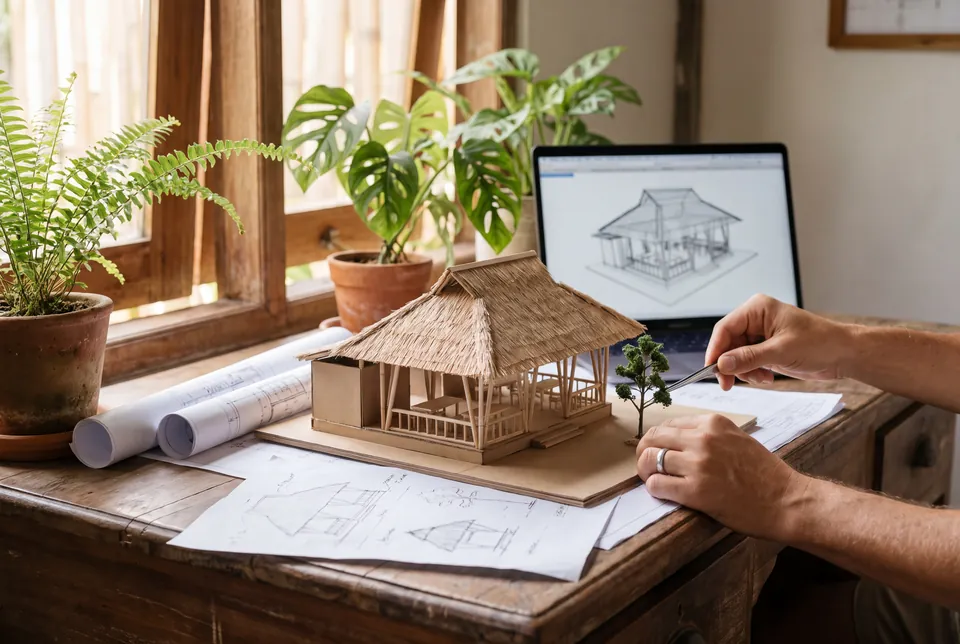
How to start a business in Bali: seven steps in order.
- 01
Name the activity and test its code
Every activity has a five-digit KBLI (business classification code) and a risk tier. Since 2026 the licensing portal rejects new foreign-owned companies in Bali under low-risk and medium-low-risk codes (Emerhub, May 2026). Have an agent test your code first.
- 02
Check the plot or unit
Zoning comes before price. Governor's Instruction 5/2025 bars commercial buildings from protected rice fields. Agree lease terms only after the zoning status is confirmed.
- 03
Incorporate the PT PMA
A notary drafts the deed and the shareholders pay in the capital.
- 04
Obtain the business number and licence
The business number (NIB) and the risk-based licence are issued through the OSS portal. Published guides give 4–8 weeks for company and number together.
- 05
Sign the lease as a notarial deed
The company that will hold the licences should be the tenant. Ask the notary how to sequence the lease and the incorporation.
- 06
Build or fit out
A new building needs a building approval (PBG) before work and a certificate of worthiness (SLF) after it. A fit-out in an existing shell takes 2–3 months according to Amoda (February 2026).
- 07
Certificates, staff, tax registration, opening
Sector certificates such as the hygiene certificate for food businesses, hiring at or above the minimum wage, and tax registration.
How much it costs to start a business in Bali: set-up fees.
| Item | Reported fee | In US dollars |
|---|---|---|
| PT PMA incorporation through an agent | IDR 25–60 million | about USD 1,500–3,600 |
| Business number (NIB) | IDR 1–3 million | about USD 60–180 |
| Tourism registration | IDR 3–8 million | about USD 180–485 |
| Health and sanitation certificate | IDR 2–5 million | about USD 120–300 |
| Building approval and worthiness certificate (PBG, SLF) | IDR 3–10 million | about USD 180–610 |
| Alcohol licence | IDR 5–15 million | about USD 300–910 |
| Company set-up for a small restaurant, broker's figure | Quoted in dollars | USD 2,000–3,000 |
Sources: MistSystem, “Cost to open a café in Bali”, 11 April 2026 (rows 1–6); DDA Real Estate, October 2025 (row 7). Dollar figures converted at IDR 16,500 per US dollar. Agent fees only: capital, rent, construction and equipment are separate.
PT PMA minimum capital after BKPM Regulation 5/2025.
The fees above are small beside the capital rules. The PT PMA minimum capital is IDR 2.5 billion (about USD 150,000) paid up per company. It was IDR 10 billion until BKPM Regulation 5/2025 came out on 2 October 2025, and many older guides still print the old figure.
The capital is not a fee. It is your company's own money. The law firm Withers reported in October 2025 that the money is to remain in the company's account for a year, except where it goes into capital expenditure or working capital. For a business that builds or fits out premises, the build consumes it.
On top of that sits the investment plan: more than IDR 10 billion (about USD 606,000), excluding land and buildings. It is counted for each business code at each location; food and drink gets a wider count, one plan per regency or city (Hukumonline, June 2026).
Note the gap. Our indicative 2026 range for an 80-seat new-build restaurant is IDR 3.5–4.7 billion (about USD 213,000–286,000), well below the plan figure. How the plan is declared and reported over time is a question for your licensing agent; we supply the build budget they work from.
Timeline: weeks for the company, months for the premises.
Published guides give 4–8 weeks for the company and its business number (MistSystem; Amoda). Premises take longer. Amoda's February 2026 guide allows two to three months to fit out a ready shell and four to six for a bare shell or a complicated job. Alcohol licensing adds 2–3 months and halal certification 2–4 months, according to the same group of sources.
For a restaurant, our own planning estimate is 3–6 months for a fit-out and 9–14 months for a new build, counted from a checked plot to the first service. It is an estimate, not a statutory term; the month-by-month timeline shows what it is made of.
One detail for readers of older guides: the portal moved new filings to the 2025 edition of the KBLI code list in mid-June 2026, as consultancies report, so check codes copied from earlier articles.
Premises and staff: the costs after incorporation.
Premises
Rent is paid in advance. MistSystem's April 2026 guide describes a deposit of one to two years upfront and a minimum two-year lease for a café-size unit, with annual rents from IDR 50–200 million in Ubud to IDR 150–350 million on a main road in Canggu (about USD 3,000–21,000). Land for a new build is leased per are (100 m²) per year. Numbers by area are on the area pages and in the area comparison; the clauses to check are in the lease guide.
Staff
The Governor's Decree on 2026 minimum wages sets IDR 3,791,003 a month in Badung, IDR 3,499,879 in Denpasar and IDR 3,316,798 in Gianyar. Market pay runs above that: MistSystem lists a server at IDR 3.8–4.5 million, a barista at IDR 3.8–5 million, a cook at IDR 4–6 million and a manager at IDR 7–12 million a month.
Fit-out
Amoda quotes IDR 4–15 million per m² for an outlet build across Indonesia, without professional kitchen equipment. Our own Bali ranges follow.
Worked example: the start-up budget of a restaurant.
Indicative ranges for 2026 from our own site cost data. A fixed price follows drawings and a bill of quantities. Land lease and working capital are separate.
Taken together for an 80-seat new build at the middle finish level, these lines come to IDR 3.5–4.7 billion (about USD 213,000–286,000) including pre-opening and an 8% reserve. Run your own seat count in the cost calculator.
Taxes after Government Regulation 20/2026.
We are builders, not tax advisers. This is a summary of published sources to take to one.
- Corporate income tax: 22%. Under Article 31E, a company with turnover up to IDR 50 billion (about USD 3 million) pays half the rate on the profit attributable to its first IDR 4.8 billion of turnover, an effective 11% on that slice (ASEAN Briefing).
- The 0.5% turnover tax is gone for companies. Since 22 April 2026, Government Regulation 20/2026 reserves it for individuals, one-owner companies and cooperatives and treats a PT PMA as a standard company, according to bali.live. Companies already in the scheme may reportedly finish their original three-year period.
- Restaurant tax. A restaurant adds 10% regional tax to the bill and passes it to the regency. Law 1/2022 caps this tax at 10%.
- Entertainment tax. Bars, nightclubs, karaoke and spas sit in a 40–75% band under the same law, as reported by Pajakku; Badung planned a move from 15% to 40%. How a venue is licensed decides which rate its bar sales carry.
- Dividends. Ask your adviser about withholding tax on profit paid to a shareholder abroad and the treaty with your country. We do not quote a rate.

Starting a business in Bali as a foreigner: the part we take on.
If the business is a restaurant, café, bar or beach club, we cover the physical half of the list above and coordinate the rest. We check the site and its zoning, design the venue, obtain the building approval and worthiness certificate, build with the Kimo Construction team, install the kitchen, and work with partner notaries and licensing agents on the company and licence set. The route is described in opening a restaurant in Bali and how we work; the licence list is on the licences page.
If your business is something else, we are not the right team, though the steps and capital rules above still apply. If you would sooner take over a running venue, read how to buy a business in Bali first.
To start, message us on WhatsApp with the area, the seat count, what you hold (land, a building or nothing yet), your budget and a target opening date.
Questions we get on WhatsApp
How much does it cost to start a business in Bali?
Agents quote IDR 25–60 million for incorporating a PT PMA, but the real entry cost is the capital: IDR 2.5 billion paid up. Premises, fit-out and staff come on top. For a restaurant, the calculator gives a first range.
How much is the PT PMA minimum capital after the 2025 change?
IDR 2.5 billion paid up per company, plus a declared investment plan of more than IDR 10 billion that leaves out land and buildings (BKPM Regulation 5/2025). Pages quoting IDR 10 billion paid up are out of date. See the licences page.
What does a PT PMA in Bali cost to set up, and how long does it take?
MistSystem's April 2026 price list gives IDR 25–60 million for incorporation and IDR 1–3 million for the business number; published guides give 4–8 weeks. The build programme that follows is in our timeline guide.
Can I start a small business in Bali as a foreigner?
Only if its code is open. Bali's 2026 restriction turns away new foreign-owned companies whose code is low or medium-low risk, as Emerhub reported in May, and the capital rules are the same for small and large ideas. Owning a business in Bali explains what is open.
Do I need an Indonesian partner or nominee?
Not where the activity allows a fully foreign-owned company, and restaurant code KBLI 56101 does (Hukumonline, June 2026). Bali Regional Regulation 4/2026 is reported to ban nominee arrangements for land. See can a foreigner open a restaurant in Bali.
Which taxes does a foreign-owned company pay in Bali?
Corporate income tax at 22%, with a lower rate on the profit from the first IDR 4.8 billion of sales for smaller companies, and no access to the 0.5% turnover scheme since April 2026, as reported. A venue selling alcohol should settle the entertainment-tax question first; see opening a bar.
Read next
Owning a business in Bali
Owning a business in Bali in 2026: what a foreigner can and cannot own, PT PMA capital of IDR 2.5 billion, the OSS block, audits. Questions on WhatsApp.
Cost to open a restaurant
2026 budget to open a restaurant in Bali, line by line: build, kitchen, licences, rent and staff, with an 80-seat example and sources. Ask on WhatsApp.
Licences
Bali restaurant license map for 2026: PT PMA capital, KBLI 56101, NIB, hygiene certificate, PBG and SLF, taxes, the OSS restriction. Ask on WhatsApp.